Unleashing Depth: The Creative Power of 3D Shark Layered Cut Files
In the world of digital fabrication, few visual elements capture attention quite like a well-executed layered design. When you combine that technique with an iconic silhouette like a shark, you get something far more compelling than a flat sticker or a simple decal. This is where 3D Shark Layered Cut Files come into play, offering crafters, designers, and small business owners a unique way to add dimension, drama, and detail to their projects. Whether you are looking to create a striking wall art piece for a marine-themed nursery, a custom trophy for a fishing tournament, or a sophisticated display stand, understanding how these files work is essential to getting the best result.
The beauty of layered cutting lies in its ability to simulate depth without requiring complex molding or casting processes. By stacking multiple layers of material—each slightly smaller than the one beneath it—you create a staircase effect that draws the eye inward. For a subject as dynamic as a shark, this technique highlights the curvature of the body, the sharp angle of the dorsal fin, and the sleek taper of the tail. It transforms a two-dimensional outline into a three-dimensional object that feels tangible and alive.
What Makes These Files Different?
Not all cut files are created equal, and the distinction between a standard SVG and a true layered design file is significant. A standard vector file might give you the outer shape of a shark, but a 3D Shark Layered Cut File provides the internal geometry required to build volume. These files are meticulously engineered so that each layer aligns perfectly with the next. When you look at the source data, you will see distinct paths representing the base layer, mid-tones, and highlight areas. This precision ensures that when the pieces are assembled, there are no awkward gaps or misalignments that could ruin the illusion of depth.
This level of detail is particularly important for organic shapes. Unlike geometric designs, which rely on straight lines and perfect angles, a shark has flowing curves and subtle contours. The layered approach allows you to capture those nuances. For instance, the transition from the broad head to the slender tail can be smoothed out by carefully selecting the thickness and shape of intermediate layers. This results in a final product that looks professionally crafted rather than hastily assembled.
Technical Specifications and Digital Delivery
One of the most convenient aspects of purchasing these digital assets is the ease of access. Upon completion of your purchase, your 3D Shark Layered Cut Files will be delivered as an instant digital download. There is no waiting for shipping, no physical inventory to manage, and no risk of damage during transit. You receive the files immediately, allowing you to start planning your project right away.
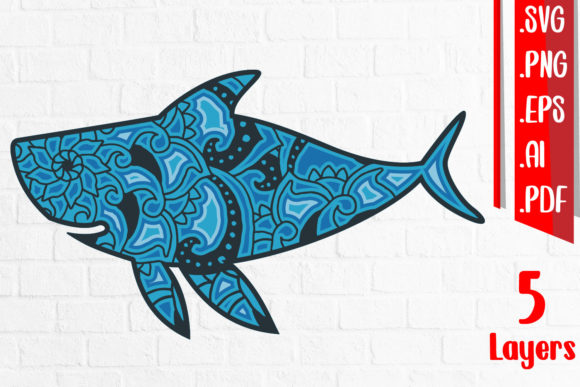
The versatility of the package is another key selling point. Typically, these downloads are provided as a comprehensive zip file containing a variety of formats to suit different software needs. You can expect to find:
- AI (Adobe Illustrator): Ideal for professional designers who need to edit node points and colors within Adobe’s ecosystem.
- EPS (Encapsulated PostScript): A robust format compatible with many older and newer vector programs, ensuring broad accessibility.
- SVG (Scalable Vector Graphics): The go-to format for many laser cutters and CNC machines due to its lightweight nature and scalability.
- PDF (Portable Document Format): Useful for previewing the design or for use in certain printing workflows.
- PNG (Portable Network Graphics): High-resolution raster images included for quick visualization or reference before cutting.
Having these multiple formats means you are not locked into a specific brand of software. If you switch from CorelDRAW to Inkscape, or if you need to send the file to a friend who uses a different program, the compatibility is largely maintained. However, it is always wise to check the specific requirements of your cutting machine’s software to ensure seamless integration.
Material Choices and Machine Compatibility
The success of a layered project depends heavily on the materials you choose. While the digital file is only half the equation, the physical medium brings it to life. These designs are prepared for a range of cutting technologies, including laser cutters, CNC routers, and even manual die-cutting machines for simpler applications. Because the design relies on precise cuts, the material must be consistent in thickness and free of warping.
Plywood is perhaps the most popular choice for beginners and hobbyists alike. Its natural grain adds warmth and texture, making it perfect for rustic or nautical decor. Baltic birch plywood, in particular, offers minimal voids, resulting in clean edges and strong structural integrity. MDF (Medium Density Fiberboard) is another excellent option, especially for painted finishes. Since MDF has a uniform surface without grain, it allows for vibrant paint jobs that hide any minor imperfections in the cut. It is also generally more affordable than hardwoods.
For a more modern, industrial look, consider using Plexiglas or Acrylic. Clear or colored acrylic can create stunning light-diffusing effects, especially if you plan to backlight your shark sculpture. The smooth surface of acrylic yields incredibly crisp edges when cut with a CO2 laser, enhancing the clarity of the layered design. Metal is a less common but highly durable option, suitable for commercial signage or high-end displays. Cutting metal requires more powerful machinery, such as fiber lasers or plasma cutters, but the result is a permanent, weather-resistant piece.
Practical Applications and Project Ideas
So, what can you actually do with a 3D Shark Layered Cut File? The possibilities are limited only by your imagination and the scale of your workspace. One of the most popular uses is wall art. A large-scale layered shark mounted on a wooden plank can serve as a dramatic focal point in a man cave, office, or coastal home. The interplay of shadows cast by the layers adds movement to the static image, making the shark appear to swim across the wall.
Beyond wall decor, these files are excellent for creating dimensional logos. Small businesses in the marine industry, fishing charters, or water sports equipment shops can use the design to create branded merchandise. Imagine a shelf-ready display unit made from layered wood, featuring the shark logo prominently. It stands out against flat printed signs and communicates quality and attention to detail.
Another creative application is in educational settings. Science teachers or museum curators might use layered models to explain anatomy or marine biology. By labeling different layers or using different colors for various parts of the shark’s body, you can turn a decorative item into an interactive learning tool. Children love touching and assembling these pieces, which helps reinforce concepts about structure and form.
Assembly Tips for a Professional Finish
While the cutting process is automated, the assembly is where your personal touch comes in. To achieve a seamless look, precision is key. Start by organizing your layers in order, from largest to smallest. Use double-sided foam tape or specialized spacers between layers to maintain consistent depth. If you are using wood glue, apply it sparingly to avoid seepage that could mar the finish.
Consider the orientation of the grain. Aligning the grain direction across layers can create a cohesive visual flow, while contrasting grains can add textural interest. Also, think about the background. A dark-colored backing board can make lighter wood layers pop, while a white backing can enhance the brightness of acrylic or painted MDF. Experimenting with these variables allows you to customize the final aesthetic to match your interior design or branding guidelines.
Finally, don’t underestimate the importance of finishing touches. Sanding the edges lightly can remove any burrs left by the cutting process, giving the piece a polished feel. Applying a clear coat of varnish or sealant protects the material from moisture and wear, extending the lifespan of your creation. With careful preparation and execution, your 3D Shark Layered Cut Files will transform from digital code into a stunning physical artifact that commands attention and sparks conversation.